Use cases · for work

The reading list that writes itself.

A lot of what matters in your industry gets said on YouTube first: press conferences, keynotes, product reviews, hearings, conference talks. Nobody on your team has time to watch it all. KnowStash watches for you and turns it into notes you can search, plus a newsletter that arrives already written.

Each example below is one monitor: a few sources, the actions it runs, how often, and an email. It takes about five minutes to set up on the Monitor page (the guide walks through it). One credit is about an hour of video; the full price list is on the pricing page.

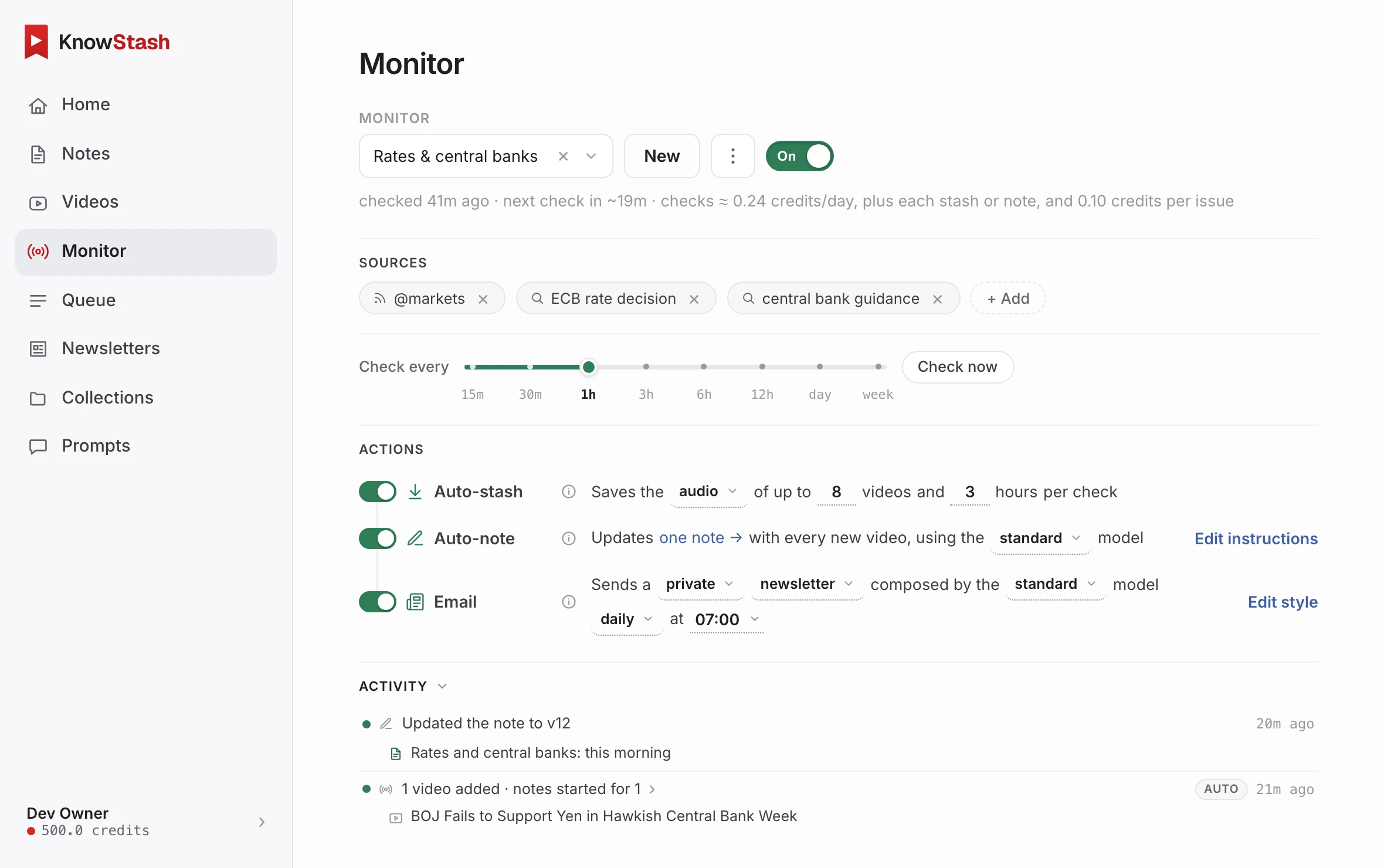
The Monitor page at knowstash.ai for a “Rates & central banks” queue, switched on: a Bloomberg Television channel source plus two searches, hourly checks, Auto-stash on, Auto-note keeping one brief up to date, a daily Email newsletter at 07:00, and an activity log of the last checks.

A markets team's monitor, as it looks in the app: one channel and two searches, checked every hour. Each new video is saved and noted with the team's instructions, and a newsletter of the new notes goes out every morning at 07:00.

Use cases

Markets · research teams · investors

A morning brief from the channels your team trusts

Central bank press conferences, earnings calls, the two or three market commentators your team actually follows. It's all on YouTube within hours, and nobody has ninety minutes a day to watch it. A monitor checks the channels every hour, saves what's new, and writes a note per video using your instructions: what was said about rates, what changed since last time, the key quotes with timestamps. Every morning a newsletter arrives with the night's notes, already sorted into sections.

  • The brief is in your inbox before markets open. Every issue is kept and every note is searchable.
  • Quotes come with timestamps, so you can check a claim against the moment it was said
  • Months later, “what did she say about wage growth in March” is a search, not a rewatch
  • With the Team plan the newsletter goes to the whole team, and everyone works in one shared library
MonitorRates & central banksOn
Sources
Bloomberg TelevisionFed press conferenceECB press conference
Checks
Every hour
Auto-stash
Saves the audio of up to 10 videos per check
Auto-note
Writes a standard note for each new video: “What was said about rates, inflation and growth; what changed since the last time; the key quotes with timestamps.”
Email
Sends a newsletter daily at 07:00

Runs on about a credit per hour of video, plus a hundredth per check and a tenth per issue sent.

Product marketing · strategy · competitive intelligence

One note per competitor that keeps itself up to date

Launch keynotes, hands-on reviews, comparison videos. Competitors say more on YouTube than in their press releases. Set up one monitor per competitor: their channel, plus the searches reviewers use. With Auto-note in “update one note” mode, every new video gets folded into a single note that grows over time, with versions, so the document you open before a roadmap meeting is always current. If you'd rather have a note per video, put them in a collection per competitor and get a weekly newsletter of what changed.

  • One note per competitor, updated without anyone having to ask
  • Pricing, claims and what reviewers complained about, in their own words
  • A weekly newsletter of what changed, sent to your team
  • Exports as Markdown, so it drops straight into Notion or Confluence
MonitorCompetitor · AcmeOn
Sources
AcmeAcme reviewAcme vs
Checks
Every 6 hours
Auto-stash
Saves the audio of up to 5 videos per check
Auto-note
Updates one note → with every new video, using the standard model: “Features announced, pricing mentioned, claims made, what reviewers criticised. Date each entry.”
Email
Sends a newsletter weekly on Mon at 09:00

A twenty-minute review costs about a third of a credit to save, and a few hundredths to fold into the note.

Brand · PR · agencies

Know within the hour when a big review lands

The reviews that move a product are twenty minutes long, and they're on YouTube. Set up searches for your brand and product names, checked every hour. Each new video gets a note: the overall tone in one line, then the specific praise, complaints and feature requests as quotes, and who made the video. A digest reaches you as soon as something lands. Over time the complaints become a searchable log, and at the end of the month you can pick that month's notes and ask for one summary.

  • An email within the hour of a new review going up
  • Praise and complaints kept word for word, searchable by product and month
  • A monthly summary written from all of that month's notes
  • Agencies: one monitor and one newsletter per client, shared by link
MonitorBrand watch · AcmeOn
Sources
Acme reviewAcme unboxingAcme problems
Checks
Every hour, videos from this quarter only, Shorts skipped
Auto-stash
Saves the audio of up to 10 videos per check
Auto-note
Writes a standard note for each new video: “The overall tone in one line, then the specific praise, complaints and feature requests as quotes. Who made the video and how big their audience is, if they say.”
Email
Sends a digest instantly after each check that found something

A quiet hour costs a hundredth of a credit. A busy launch week costs about a credit per hour of reviews.

Product management · UX research · customer insight

What customers actually say, across every review ever posted

Long reviews, “a year with” videos, community how-tos. They're customer interviews you never had to schedule. Queue thirty of them, save them all with one empty send, then ask one question across all of them: every complaint and workaround, grouped by feature, with who said it. Save the question as a prompt and you can run the same study again next quarter on the new batch. A monitor on the same searches keeps the queue filling up in between.

  • One note written across dozens of videos, with the reviewer named for each point
  • Saved prompts, so the whole team asks the same questions the same way
  • Questions scoped to the one chapter that matters
  • Markdown export for your research notes
QueueAcme · reviews32 videos
Stash
Send the composer empty: all 32 videos fetched and indexed, once
Ask
One from all: “List every complaint and workaround mentioned, grouped by feature, with the reviewer and the timestamp.”
Prompt
Saved as Customer complaints, picked from the + menu next time
Monitor
Sources Acme reviewa year with Acme keep the queue filling; Auto-stash on, Auto-note off

About a credit per hour of video to save the queue, then a tenth of that for each question you ask across it.

Public affairs · compliance · legal operations

Hearings and regulator briefings, on file the same day

Committee sessions, regulator webinars, agency briefings. Hours of video on official channels, and someone has to sit through them for the two decisions that matter. Point a monitor at the channels. Each new session gets a note: decisions, deadlines, obligations, who said what, with a timestamp to cite. Fold a topic into one growing note (“AI Act, running brief”) and the reference document keeps itself up to date. A weekly newsletter keeps the wider team in the loop.

  • Decisions and deadlines pulled out, each with a timestamp you can check
  • One running brief per topic, with versions, always current
  • Pick the premium preset for a three-hour hearing
  • A weekly newsletter to the people you choose, with the Team plan
MonitorAI Act · watchOn
Sources
European ParliamentAI Act implementationAI Office webinars
Checks
Every 12 hours, videos over 10 min only
Auto-stash
Saves the audio of up to 5 videos per check
Auto-note
Updates one note → with every new video, using the premium model: “Decisions, deadlines and obligations for providers and deployers; who said what; date each entry.”
Email
Sends a newsletter weekly on Fri at 16:00

A three-hour hearing costs about three credits to save, and about the same again to fold into the brief with the premium preset.

Leadership · consultants · analysts

A conference, read in an afternoon

The recordings come out a week after the event: eighty talks, with the five that matter somewhere among them. Add the playlist as a source. Auto-stash and Auto-note run overnight with one instruction: the claim, the evidence, the ask. In the morning, one note written from all the talk notes gives you the themes, and the per-talk notes tell you which five to actually watch. Consultants do the same for a client's industry and pass the weekly issue on, a briefing that writes itself.

  • A playlist becomes a set of notes overnight
  • One summary across every talk, then a shortlist worth watching
  • A weekly briefing on a client's industry, shared by link
  • Everything exports as Markdown, ready for the deck
MonitorFintech Week · main stageOn
Sources
Fintech Week 2026 · playlist
Checks
Every hour while the recordings are landing, then weekly
Auto-stash
Saves the audio of up to 10 videos per check
Auto-note
Writes a standard note for each new video: “The claim, the evidence offered, and the ask, in that order. One line each, then the three most quotable moments with timestamps.”
Then
On the Notes page, select the talk notes and Create Note: “The five themes across these talks, and which talk argued each best.”

Eighty half-hour talks cost about forty credits to save, and about four more for the notes.

Learning & development · enablement · professional development

A study library the whole team can search

More and more of what a team learns from is public: vendor training channels, conference workshops, a specialist's YouTube channel. Turn them into study guides once, keep them in a collection per topic, and share the notes with a link. New videos on the channel arrive already noted. It works for your own learning too: a channel that's basically a never-ending course becomes one growing reference note, updated every time a lesson lands.

  • Study guides with definitions and worked examples, per video or per course
  • A collection per topic, and notes shared by link with whoever is learning it
  • A channel that teaches becomes one growing reference note
  • Markdown export for the internal wiki
MonitorTrack · Data engineeringOn
Sources
Vendor academy · channelWarehouse fundamentals · playlist
Checks
Every day
Auto-stash
Saves the audio of up to 10 videos per check
Auto-note
Writes a standard note for each new video with the saved prompt Study guide: “Key concepts with a one-sentence definition each, one worked example per concept, five questions to test with.”
Collections
Everything the queue processes lands in Data engineering

A ten-lesson course of twenty-minute videos costs under four credits, guides included.

Built for how teams actually share

One person sets it up. Everyone works in it.

And for the rest of life

The same thing, at home.

Recipe cards you can cook from

Ingredients with quantities and numbered steps, minus the sponsor read. A collection becomes the cookbook on the kitchen tablet.

Shopping without ten hours of reviews

Save the reviews for the models on your list and ask for one shortlist: what each reviewer liked, what broke, who it's for.

A study guide from a course playlist

Definitions, worked examples, and a question list to test yourself with. Revising is a search, not a rewatch.

The trip, planned from the videos

Queue the guides for the cities you'll visit and ask all of them the same question: must-do spots, days to plan, one thing to avoid.

Try it on this week's videos.

Create a free account, point a monitor at the channels your work depends on, and see what arrives tomorrow morning. The first 3 credits are on us.

3 free credits to start · works in any browser · the step-by-step guide covers the first note